
 Albany, GA | June 15, 2026 – For nearly two years, Karla Frazier was having trouble breathing. “I started getting tired and short of breath when I was walking. I thought it could be asthma,” the 57-year old from Camilla said. The undiagnosed condition made it difficult for her to handle her job, work in her yard and fully enjoy being with her grandchildren, but she says, “I would just keep on going.”
One Sunday morning in April 2025, she felt so bad she went to the ER in her hometown hospital. Her heartrate was so low, the doctor wanted to admit her. “I just went to see if I had a cold or something. I wasn’t ready to stay in the hospital,” she said.
 Frazier left, but the doctor made her promise she would seek advanced care at Phoebe the next day. She lived up to that promise. “The next morning, I washed my clothes, took my grandbabies to my mother’s house, then went to the ER in Albany,” she said.
At Phoebe, Frazier was admitted to the hospital and diagnosed with bradycardia – a condition where the heart beats too slowly or pauses, depriving the body of oxygen – and she was told she needed a pacemaker.
“I had great nurses. They got me everything they could on the pacemaker because I wanted to read up on it. My nurses and my children talked to me about it, and I went on and made up my mind to do it,” Frazier said.
 Phoebe Electrophysiologist Dr. James Coman decided the best option would be the Micra AV, the world’s smallest pacemaker. “Micra is a leadless pacemaker that can be implanted in about six minutes through an IV in the vein of the leg. There are no cuts needed on the chest as with a typical pacemaker, and the battery lasts for about 12 years. Not every patient is a candidate for this device, but for those who are, it represents a leap forward in comfort and management for those specific patients,” Dr. Coman said.
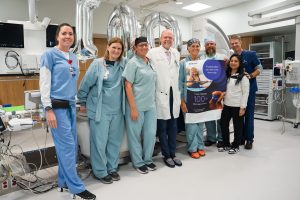
Phoebe was the first hospital in the region to utilize the device, and Dr. Coman recently became the first physician to implant the Micra in 100 patients in south Georgia. “Our volume has risen significantly over the last few years,” Dr. Coman said. “Patients have no awareness the device is in their heart, and there are no long-term restrictions after one is placed. These devices are also extremely hard to infect, so they are great choices for patients at the highest risk for recurrent infections,” he added.

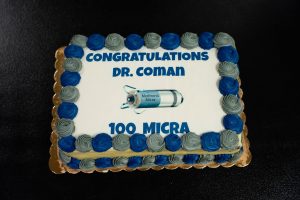
The device, which is about the size of a large vitamin capsule, continuously monitors the heart’s electrical activity and delivers tiny electrical impulses to keep it beating at a normal, steady pace. It has an outstanding success rate, and it has certainly worked for Karla Frazier.
Frazier’s pacemaker has truly been a life-changer. She says she’s back to full activity at work, and she no longer struggles to do yardwork or play with her grandkids. “I was kind of skeptical, but it’s been great.”
South Georgians who believe they need to be evaluated to determine if they need a pacemaker should talk to their primary care physician or cardiologist. They can also call Phoebe Electrophysiology at 229-312-7790 for more information.