
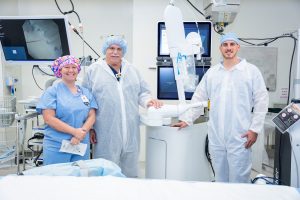
 Albany, GA | September 18, 2025 – Phoebe Pulmonology has reached a major milestone, completing its 200th ION bronchoscopy procedure at Phoebe Putney Memorial Hospital. This advanced, minimally invasive technology allows pulmonologists to biopsy lung nodules with unmatched precision, giving patients quicker answers and faster access to life-saving care. Dr. James Palazzolo led the team that recently performed the milestone procedure that Phoebe introduced last year.
Phoebe Pulmonologist Dr. Joseph Watson says the ION system has transformed lung cancer detection and treatment pathways at Phoebe.
“The whole goal of this technology is to catch cancers or abnormalities earlier, because we know treatment and survival rates are much better the sooner we find them. We’ve been able to diagnose patients quickly, often within just a few weeks of their initial imaging, and get them into treatment much faster than traditional methods would allow,” Dr. Watson said.
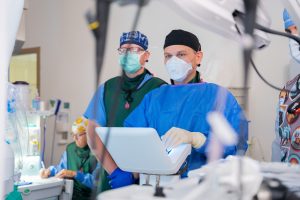 Phoebe also recently launched a dedicated Pulmonary Nodule Clinic to proactively search for suspicious nodules and ensure they are addressed without delay. When a patient has a CT scan for any reason – not necessarily related to possible lung problems – at any Phoebe location, radiologists examine the images looking for potential lung abnormalities. If a possible nodule is present, the patient is referred directly to Phoebe Pulmonology where they are typically seen within two weeks. If a patient needs an ION bronchoscopy, it is typically completed within four to six weeks, and the patient receives a diagnosis and can be referred to oncology or thoracic surgery teams, if needed.
“That timeline is significantly faster than what many patients experience across the country. Having seven pulmonary physicians trained on ION, with an eighth joining, soon, allows us to move patients from detection to treatment in a matter of weeks, not months,” said Dr. Watson.
Among the first 200 ION procedures, Phoebe physicians have identified several early-stage cancers that otherwise may have gone undetected until later stages. In multiple cases, patients were able to undergo surgery quickly after biopsy, with a strong chance of cure.
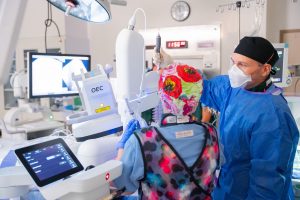 “Even in situations where a nodule looked like an infection or something benign, the ION allowed us to biopsy and discover cancer at an earlier stage. That means we could get patients into surgery and potentially cure them before the disease spreads,” said Dr. Watson.
Unlike traditional surgical biopsies, the ION procedure does not require external incisions. Using robotic navigation through a patient’s natural airways, pulmonologists can reach nodules deep within the lungs.
“Because we don’t have to make cuts into tissue, patients recover much faster. Most tell me they feel back to normal by the next day, aside from being a little tired from anesthesia. That’s a huge difference compared to the recovery from a surgical biopsy,” said Dr. Watson.
As Phoebe physicians gain experience, the efficiency and accuracy of ION procedures continue to improve.
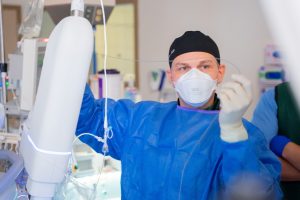 “This technology is advancing quickly, and we’re proud that Phoebe has been forward-thinking in investing in it. It’s not only improving outcomes for our patients but also positioning us as a leader in lung cancer detection for the entire region,” said Dr. Watson.
Beyond the technology itself, Phoebe hopes to use milestones like the 200th procedure to encourage more conversations about lung cancer screening. “Too many lung nodules go unnoticed or are never followed up. If we can get more people screened and put them into care earlier, we can save lives. That’s the bigger mission,” said Dr. Watson.
As Phoebe celebrates this achievement, the focus remains on what matters most, helping more patients receive answers sooner and improving outcomes for families in the region. Phoebe will continue to build on its mission to detect lung cancer earlier, treat it more effectively, and give every patient the best chance at long-term survival.